
Science Tutoring Herne Bay Kent (CT6): The educational progress and grades of your child are undoubtedly a top priority as a parent residing in Herne Bay. Identifying the moments when additional support becomes imperative is crucial. When faced with difficulties in comprehending science lessons, enlisting the help of a science tutor can prove to be immensely beneficial.
For the benefit of your child, it is imperative to locate a proficient science tutor in Herne Bay. Fortunately, in today's digital age, finding a suitable tutor has become remarkably convenient. With just a computer and internet access, you can effortlessly navigate through numerous tutor profiles in the Herne Bay area, all from the comfort of your own home. Online platforms allow you to examine diverse tutor profiles and select the one that best aligns with your child's needs. Furthermore, many websites also provide contact information for the tutors, enabling you to engage with them through messages or phone conversations. You can also make an enquiry HERE.

Though there are also several other ways available to search for a tutor in the Herne Bay area, such as references, newspaper ads, etc, there is no other medium as effective as the Internet. You can save time online and filter your searches to find private home tutors in the subjects your child is having problems with. You will be able to find one suiting your convenient timing and budget. Before hiring, always remember to check the qualifications of the candidate. A little research and thinking will help you get a very experienced tutor to guide your child and improve his or her science grades.
In Herne Bay, private science tutoring could be the optimal solution if your child struggles with studying in groups. By opting for one-on-one tutoring, your child will have the opportunity to address any concerns, ask the tutor numerous questions, and overcome any anxieties. With the comfort and security of studying at home, your child can learn more effectively without the fear of being ridiculed or judged.
A good science tutor in Herne Bay will normally begin by identifying the specific areas that your child finds difficult, rather than immediately diving into worksheets. Short assessments or informal discussions can help them to understand whether the issue is down to knowledge gaps, exam technique, or confidence. Once this is clear, they can set small achievable goals so your child experiences regular success instead of feeling overwhelmed.
Private science tutors not only help your child with their homework but also utilize real-life examples to explain various scientific concepts, stimulating your child's curiosity and providing consistent encouragement.

Consistency plays a large role in whether science tutoring makes a lasting difference. Weekly sessions create structure and prevent topics from being forgotten between lessons, especially in subjects such as chemistry and physics where concepts build on each other. Over time, the routine itself often reduces stress because your child will know that there is always an opportunity to revisit anything that is confusing.
Get Your Child Interested in Science
Many parents in Herne Bay have experienced a common trend in children when it comes to science. The subject is one that is met with discontent and a lack of overall interest. But there is not any reason for your child to remain hostile to the subject matter, instead take the chance to use your child's natural curiosity to help them find a passion for science. Things that happen in their day to day schedule can all be forms of science.
In Herne Bay, parents commonly believe that they lack the ability to guide their children in science, assuming it requires a specific level of understanding. However, if you can explain the reasons behind phenomena and help your child determine the workings of things, you are already making progress.

Take a moment to ponder your fundamental understanding of science. When you were in school, what knowledge did you acquire, and how was the learning process centred around science? It often revolved around grasping basic cause and effect concepts. Utilize this knowledge to embark on an exploration of the world with your child, prompting them with intriguing questions. Dedicate time to delve into the basics of science and involve them in seeking solutions when they ask questions. For example, why does it rain? Instead of delivering a mundane explanation, transform it into an exciting project that both of you can enjoy.
Building upon that foundation, you can delve into the diverse array of clouds present in the sky and unravel the factors that contribute to atmospheric humidity. This exploration can then inspire you to compile a list of inquiries that further probe the concept, observing your child's fascination with the learning journey.
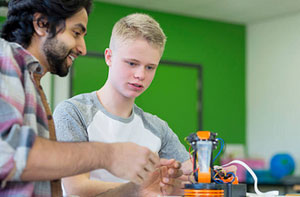
As exams approach, a tutor can also focus on past papers and common question patterns that schools may not have time to practise repeatedly. Learning how marks are awarded will often improve grades just as much as learning new content. When students understand what examiners are looking for, they will usually approach tests with far more confidence and far less panic.
An important reminder is to never judge or disregard their contributions when they ask questions or propose corrections while answering. Instead, focus on acknowledging the aspects they answered correctly and then provide guidance towards the correct solution for the parts in which they made errors.
Another way to help get a child about science is to teach them all about chemical reactions while they are cooking or baking. For example, take a moment to add vinegar to milk and watch how it curdles, or melt down sugar into sweet syrup. You can then discuss the tasty treats you make and explain why the reaction happened.
The children in Herne Bay are all unique, with different interests, so it is important to discover an aspect of science that excites them. Some may adore animals, while others may find joy in kitchen exploration. There are even children who are fascinated by rocks, so consider all these areas when developing a project that caters to their interests.
Ultimately, it is vital to acknowledge your child's individuality. If they encounter difficulties in understanding science, start with a straightforward yet enjoyable project that sparks their interest, and then gradually expand upon it. Avoid pushing them to the point of struggle. Instead, allow them to learn at their own pace and create a supportive atmosphere that encourages questions. By nurturing their confidence, you can also cultivate their passion for science.
Science lessons can be found in Herne Bay and also nearby in: Herne Common, Hersden, Hoath, Eddington, Whitstable, Beltinge, Monkton, Broomfield, Reculver, Tyler Hill, St Nicholas at Wade, Upstreet, Birchington, Broadoak, Westbere, Chestfield, Sturry, together with these postcodes CT6 5HL, CT6 5BU, CT6 5BF, CT6 5BP, CT6 5LF, CT6 5DF, CT6 5LP, CT6 5RE, CT6 5DX, CT6 5LG. Local Herne Bay Science teachers will probably have the postcode CT6 and the phone code 01227.
8 Steps to An Expert Science Lesson
Use a "Novelty" Introduction: Do not state the objective of the session at the beginning of a lesson. Simply present a "novelty" item to create interest and excitement. A novelty item can be any object that represents the subject taught in a lesson, such as a hat, puppet, costume, live animal or live/artificial plant. A novelty item is a motivator, like turning on a light bulb in a student's brain. The same novelty is used throughout the session, because this helps the student connect to the subject of the lesson. An example: if you're teaching about pine trees, present a miniature live/artificial tree.
Gain Background Knowledge: Background knowledge is gained from your students by asking a series of questions, such as: What is this? What do you know about this? What does it look like? Where have you seen this? When did you see this? What colour is it? What does it feel like? DO NOT offer any answers. Be sure to write down everything your students tell you on the board, chart, paper, etc. It is very important that your students see you writing.
State the Lesson Objective: After the background information has been collected and discussed, state the objective of the lesson. For example, say "Today we will learn the characteristics of trees." Your students have already connected to the subject and will accept the objective with meaning and understanding.
Engage Your Students: Every lesson must have an "engagement" to help students connect to the lesson objective. The three steps to engagement are:
- Introduction: Describe/show what your students will be doing during their exploration with their observation tools: hand lenses, spoons, microscopes, telescopes, music instruments, picture cards, magnets, thermometers, mirrors, rulers, etc.
- Action: Students actively participate in the exploration. they will interact with their five senses to explore.
- Display Results: Lead the children to describe their observations from the investigation, verbally, in writing, by drawing pictures, gestures, movement, songs, painting, crafts, etc. Let your students express what they have experienced.
Organise New Knowledge: Gather and organize the information that has been learned in a sequential order through questioning. Guide your students to create charts, lists, graphs (picture, bar, line, pie, etc) compare/contrast charts, a collages, pictures, and cycles.
Connect Through Literacy: Use any form of printed material connected to your subject that can further expand the knowledge of your students. For example, use books, posters, articles, pamphlets, newspapers, magazines, etc.
Connect Through Technology: Use computer technology to connect your students to the world around them. Give students vocabulary cards and guide them in using a search engine to conduct further research. It is a good idea to tape vocabulary words to the bottom of the screen for easy access. This activity will help the children identify letters and words, expand their vocabulary and develop social/emotional skills.
Let Students Summarise: Allow each student an opportunity to share one thing they learned about the subject they studied today. When students give an answer, convert it to a sentence. For example, a student may say "seeds." The teacher will respond, "Seeds are found in a pine cone." A student may say "trees." The teacher can respond, "Trees grow from seeds."
Science Tuition Activities

A local Science tutor in Herne Bay will be happy to help you with science evening classes in Herne Bay, science improvement courses, beginner science in Herne Bay, weekly science tuition, science tuition quotations, one-on-one science lessons, children's science lessons, science courses, cheap science lessons, 13 plus science tutoring Herne Bay, biology lessons, GCSE science tuition, face-to-face science tuition in Herne Bay, A-level science tutoring Herne Bay, online science tutoring, science exam preparation in Herne Bay}, science quizzes & tests, KS3 science tutoring Herne Bay, science classes in Herne Bay, pre-intermediate science lessons, science basics in Herne Bay, science lessons for kids, science tutoring, KS2 science tutoring Herne Bay, IB science tutoring Herne Bay, elementary science, English lessons, intermediate science, and other science related activities.
Science Tutoring Near Me
Also find: Hoath science tuition, Broomfield science tuition, Birchington science tuition, Herne Common science tuition, St Nicholas at Wade science tuition, Eddington science tuition, Sturry science tuition, Monkton science tuition, Upstreet science tuition, Whitstable science tuition, Chestfield science tuition, Tyler Hill science tuition, Beltinge science tuition, Westbere science tuition, Reculver science tuition, Hersden science tuition, Broadoak Science lessons and more.
Science Tuition
- Physics Tuition
- Chemistry Lessons
- Face-to-Face Science Lessons
- Science Tutoring
- Science Training
- Beginners Science Tutoring
- Science Classes
- Maths Lessons
- Science Tuition
- One-on-One Science Lessons
- GCSE Science
- Physics Lessons
- Science Studies
- Exam Preparation
Ok, so you're currently attempting to find science tutoring in Herne Bay, but you may also require driveway cleaning in the vicinity, French lessons in Herne Bay, French translation in the immediate area, German lessons in the Herne Bay area, guitar lessons in the area, dance classes in the area, cookery classes in the area, will writing in the local area, a French teacher in Herne Bay, Tai Chi lessons in the Herne Bay area, language classes in the local area, a Spanish teacher in the area, English tutoring in Herne Bay, a man with a van in the area, dog grooming in your locality, video design and production in the vicinity, foreign language lessons in the local area, French classes in the local area, financial advisers in the area, a maths tutor in Herne Bay, Spanish lessons in the Herne Bay area, fishing lessons in the local area, at some point.
 Science Tutoring Herne Bay
Science Tutoring Near Herne Bay
Science Teacher Herne Bay
Science Tutoring Herne Bay
Science Tutoring Near Herne Bay
Science Teacher Herne BayScience lessons in CT6 area, and dialling code 01227.
TOP - Science Tutoring Herne Bay - Spanish Tutoring - English Tutoring
Science Tutoring Herne Bay - Science Tutors Herne Bay - Basic Science - Science Tuition Price Quotes - Face-to-Face Science Tutoring Herne Bay - Online Science Tutoring - Science Teachers Herne Bay - One-on-One Science Tutoring Herne Bay - Science Tutor Herne Bay
